 El Nido Island Hopping Tour
Big Lagoon or Small Lagoon: Which El Nido Lagoon to Choose
Last reviewed September 2026
The Big Lagoon sits on Tour A and the Small Lagoon on Tour D, so a joiner boat reaches one or the other and never both on the same day. That is where the Big Lagoon vs Small Lagoon El Nido question starts, and it ends with two different experiences: a wide green channel between cliffs that takes about 90 minutes to paddle properly, and a shallow pool entered through a gap in the rock where reviewers report having the water to themselves. Both charge a ₱200 users fee, both are closed to engines, and both mean hiring a kayak at the mouth. This page puts them side by side on fee, kayak, tide, crowds and time, then names which route to book first. The boats are compared in the Bacuit Bay listings stop by stop.
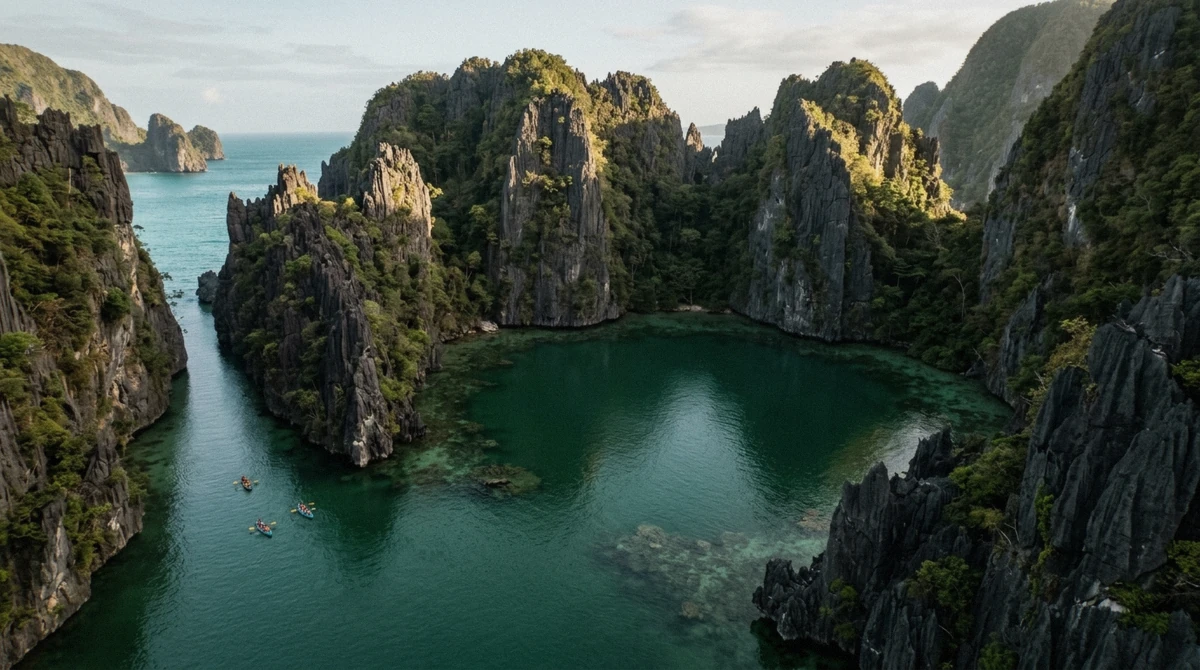
Quick answer Which route each lagoon sits on, what the kayak costs, and how long you need inside each one
Both lagoons charge a ₱200 users fee (about $3.20) and both are closed to motor boats, so you paddle in. The Big Lagoon is on Tour A and needs about 90 minutes to see properly; the Small Lagoon is on Tour D, entered through a narrow gap, and works in under an hour. One shared boat day cannot hold both.
Key takeaways
- Big Lagoon on the shared Tour A boats, Small Lagoon on the shared Tour D boats: different routes, different days
- Kayak rates run ₱250 to ₱350 for a two-seater and ₱500 for three seats at the Big Lagoon inlet
- Visitor guides report a daily cap of 400 people at the Big Lagoon on allocated slots from 7:00 am
- One listing states that if Big Lagoon entry is no longer available the boat visits a different spot instead
- At low tide the inlet is a walk over gravel and broken coral; at high tide you paddle straight in
- Want both lagoons? Two mornings, one eco fee. The sums are in what a boat day costs
The Two Lagoons at a Glance
The two lagoons are close enough together to see from the same stretch of water and far enough apart in practice that they belong to different days, different fees and different kinds of visit.
Head to head
Everything below comes from the tour listings themselves and from visitor guides who timed their own visit. The fee is identical, the kayak rate is close, and every real difference sits in the last three rows: how long you need inside, how many boats are there with you, and what happens when the day is full.
| What you are comparing | Big Lagoon | Small Lagoon | Which one wins |
|---|---|---|---|
| Route | Tour A | Tour D | Neither. This is the fork in the road, and it decides which boat you book |
| Users fee | ₱200 (about $3.20), one-time | ₱200 (about $3.20), one-time | Level. Only one listing puts the fee inside the ticket price |
| Kayak | ₱250 to ₱350 for a two-seater, ₱500 for three seats | About ₱300 an hour for a two-seater on one listing, ₱350 and ₱500 on another | Small Lagoon, narrowly, and it is the cheaper hire if you split a two-seater |
| How you get in | Motor boats may not enter. You hire a kayak at the inlet and paddle | A narrow gap in the rock, shallow water, kayak or a swim on a calm day | Small Lagoon. The gap is short and the paddling inside is easy |
| How long you need | About 90 minutes, of which 15 minutes is just reaching the main part | 45 to 60 minutes covers the pool and the archways | Big Lagoon needs more of your day than any other stop on Tour A |
| Crowds | Visitor guides report a 400-person daily cap on time slots, and boats queue at the inlet | Reviewers on the shared Tour D describe being alone at both lagoons | Small Lagoon, by a distance |
| If the day is full | One listing states you visit a different spot instead | No entry limit stated on the listings | Small Lagoon. Tour A carries a risk Tour D does not |
One more lagoon that confuses the comparison
Two other names come up in the same conversation and neither is the Small Lagoon. The Secret Lagoon is a Tour A stop, reached by wading or swimming through a hole in the rock face, and no separate fee is stated for it on the listings here. Cadlao Lagoon is a Tour D stop with no separate fee stated either, and it is the one people mean when they say Tour D has two lagoons.
So a Tour A ticket buys the Big Lagoon and the Secret Lagoon, one of which is paid and one of which is not. A Tour D ticket buys the Small Lagoon and Cadlao Lagoon, again one paid and one free. If someone tells you they did the Small Lagoon on Tour A, they either did the Secret Lagoon or they went before the routes were rearranged.
The Big Lagoon
The Big Lagoon is the stop that sells Tour A, a long green corridor of water walled in by limestone, entered only under your own paddle power.
Three parts, and the clock
The lagoon has an inlet, a main body and a left arm. The inlet is the narrow mouth where boats anchor and kayaks are hired, and it is the busiest water in Bacuit Bay on a fine morning. Past it the lagoon opens into the main part, and visitor guides who timed the paddle put fifteen minutes on that leg alone. The left arm has sharp coral at its entry, so it rewards care rather than speed.
Allow about 90 minutes to see the whole thing without turning around early. That number matters because it is longer than most stops on a joiner boat: one Tour A listing publishes 105 minutes at the Big Lagoon, which fits, while a combo day squeezing 7 to 8 stops into eight hours does not. What that means for a two-route day is covered in the combo tours page.
Getting in, and what can stop you
Entry is limited. Visitor guides report the municipality capping the lagoon at 400 visitors a day with allocated time slots, the earliest at 7:00 am and each slot around 90 minutes, and one guide's account of the system is worth reading before you book. Those figures are what guides report, not a line in a published ordinance, so treat them as the shape of the system rather than the letter of it.
The hard fact is on the listing itself. The most-reviewed Tour A here states that entry to the Big Lagoon is limited and that if entry is no longer available you will visit a different spot. That is the operator's own wording, and it is the sentence to plan around: on a busy day in season a Tour A boat can be rerouted, and the ticket does not owe you the lagoon. The shared Tour A with the Big Lagoon prints the same caveat in its inclusions.
Swimming, and what the water is like
None of the listings compared here states a swimming ban inside the lagoon, and reviewers describe swimming from their kayaks once past the inlet. Two practical limits apply anyway. The inlet is a working channel with kayaks and tenders moving through it, so it is the wrong place to be in the water. And the distance from the anchorage to the far end is longer than it looks from a boat, which is exactly why kayaks are hired at the mouth rather than optional.
The floor shelves from ankle-deep gravel at the entrance to deep green water in the middle. Reviewers mention jellyfish at the lagoons in some months, which is a rash guard problem rather than a cancellation, and the rest of the water hazards sit on the safety and restrictions page.
The Small Lagoon
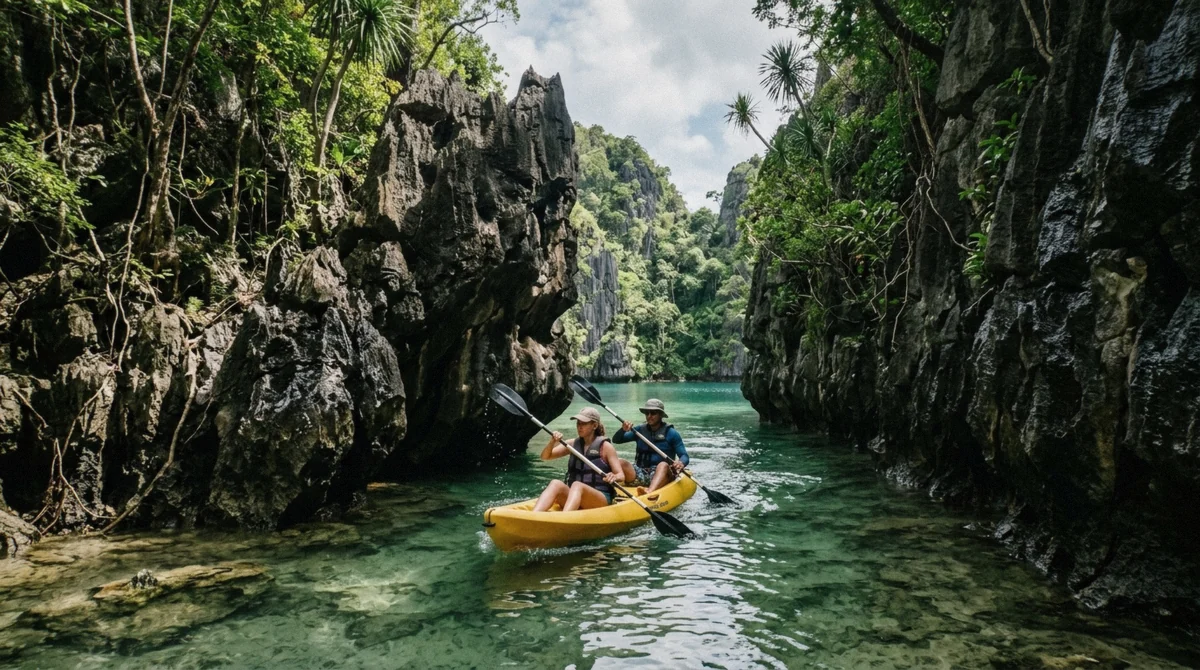
The Small Lagoon is the quiet one, and quiet is most of the argument for it. It sits on Tour D, the route closest to town, on boats that reviewers count at fifteen to seventeen passengers.
A narrow gap and shallow water
You enter through a narrow gap in the rock wall, low enough that a kayak is the sensible way through it and shallow enough inside that paddling beats swimming for covering ground. Beyond the gap the pool opens out under overhanging cliffs, with small archways at the edges that reviewers on the shared Tour D describe paddling through.
The scale is the difference. Where the Big Lagoon is a corridor you travel down, the Small Lagoon is a room you move around in, and 45 to 60 minutes is enough to see all of it. The fee is the same ₱200, and the kayak is where the listings disagree: one Tour D listing prices a two-seater at about ₱300 an hour, another puts a two-seat kayak at ₱350 and a three-seater at ₱500. Either way it is the same cash-on-the-water arrangement as Tour A.
The boats around you
Tour D is the least-sold of the four routes and the closest to town, and both facts show up in the water. Reviewers on the shared Tour D with the Small Lagoon and Cadlao count fifteen to seventeen people on their boat and describe being alone at both lagoons, which is not a sentence anyone writes about the Big Lagoon in high season.
The trade is scenery on a smaller scale and a route with fewer showpiece stops. Tour D fills the rest of its day with Cadlao Lagoon, Pasandigan Cove, Paradise Beach, Nat Nat for snorkelling and one more beach depending on the operator. It is the route people book second, after Tour A has shown them what a busy stop feels like, and the one seasoned repeat visitors book first.
Why They Are on Different Tours
The two lagoons used to share a route. They no longer do, and the reason is the same carrying-capacity thinking that produced the Big Lagoon's entry limit.
One route each, since the routes were redrawn
A municipal ordinance moved the Small Lagoon from Tour A to Tour D on carrying-capacity grounds, and the history of that decision belongs to the guide to which El Nido tour is best. What matters here is the consequence, which is absolute for anyone buying a joiner seat: the Big Lagoon is on Tour A, the Small Lagoon is on Tour D, and one shared boat runs one route.
So there is no ticket that includes both lagoons on one day. The options are two mornings on two joiner boats, or a private boat that can be sent wherever you like, and even a private A and C boat goes to the Big Lagoon and the Tour C beaches rather than to both lagoons. Two days is the clean answer, and since the ₱400 eco fee is paid once and holds for ten days, the second morning adds only the boat.
Kayak, Fees and Tides
Three things decide what the lagoons cost you and how easy they are on the day, and only one of them is on the booking page.
What you pay at the mouth
The users fee is ₱200 a person at each lagoon, one-time, paid in cash at the entrance, and it is separate from the ₱400 eco-tourism fee that covers every site in El Nido. The kayak is separate again. Rates quoted for the Big Lagoon inlet run from ₱250 in one visitor guide to ₱350 for a two-seater and ₱500 for a three-seater on one of the tour listings; at the Small Lagoon, one listing prices a two-seater at about ₱300 an hour.
Call the kayak compulsory in practice. Reviewers on the shared Tour A make the point plainly: having paid the lagoon fee, there is no other way in, so the optional line on the listing is optional only in the sense that skipping the lagoon is. The full breakdown of fees, kayaks and cash carries the arithmetic for a whole day.
The tide changes the entrance
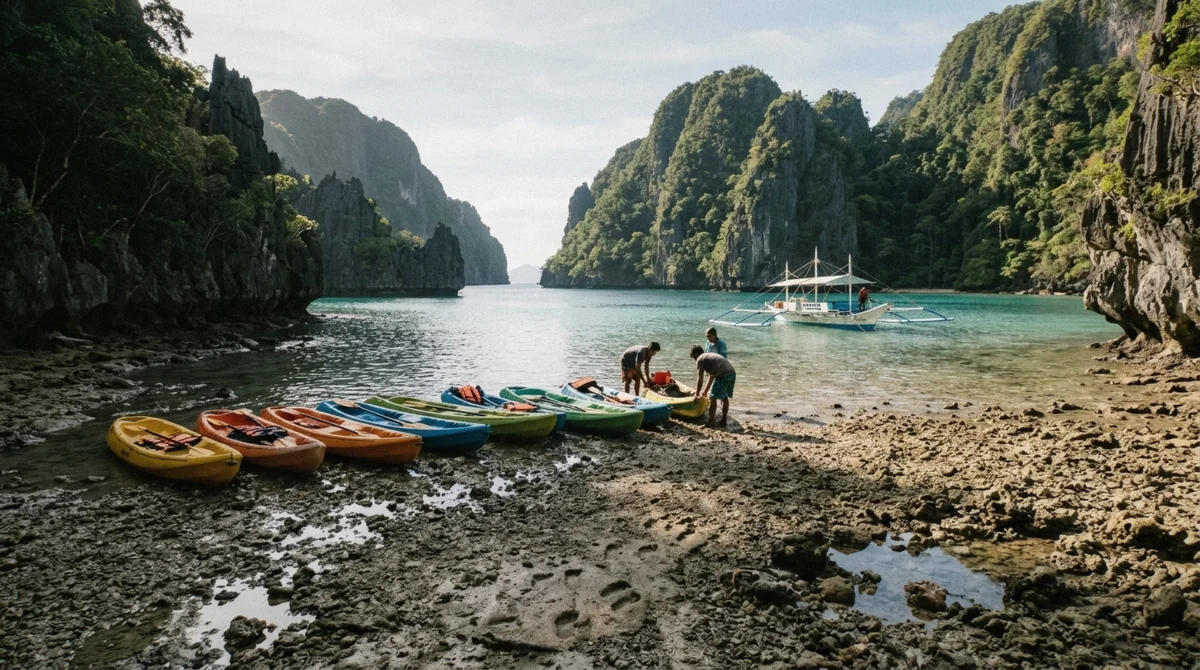
Tide is the variable nobody books around and everybody remembers. At high tide the boat anchors close and you paddle straight in through the inlet. At low tide the boat anchors further out, the water over the entrance shallows, and getting in means walking or dragging the kayak over gravel and broken coral. That is the moment reef shoes stop being a suggestion, and they rent for about ₱100 a pair where a listing does not include them.
The Small Lagoon has its own version of the same problem: the gap is low, so a swell or a low tide makes the entry fussier. Neither is dangerous and neither cancels a stop. It just changes a five-minute glide into a twenty-minute scramble, and on a boat with a schedule that comes out of your time inside.
Timing: Getting There Before the Fleet
The lagoons are not busy all day. They are busy in a window, and the window is set by when the joiner fleet leaves the town beach.
The fleet's clock
Joiner boats report between 8:30 and 9:00 am and leave El Nido town beach between 9:00 and 9:30 once the Coast Guard clearance comes through, which puts most of them at their first stop between 10:00 and 11:00. Operators stagger the order of stops precisely to avoid arriving together, so a boat that starts at Seven Commandos reaches the Big Lagoon later, and a boat that goes to the lagoon first is there in the quietest part of the morning.
You cannot choose that order on a joiner seat, and it is worth asking the office the evening before which way their boat runs. Visitor guides report the earliest allocated Big Lagoon slot at 7:00 am, which no shared boat leaving at 9:00 can reach.
What an early boat buys
A private boat can leave when it likes, and that is the one lever that reliably changes the lagoon experience. A reviewer on the private A and C boat records leaving at 7:00 a.m. and being first at every spot; another writes that the guide reordered the day to hit each sight at its least busy hour. Town operators sell the same trick on private charters as an early or late departure, roughly 8:00 am or 10:45 am instead of 9:00, or the standard route run in reverse.
On a joiner boat the equivalent lever is the route itself. Tour D's lagoon is quiet at any hour, which is the practical reason to consider it when the Big Lagoon is the thing everyone else has come for.
Which One to Choose
If the trip holds one boat day, the honest answer depends on what you want from the water rather than on which lagoon photographs better.
Book Tour A for the Big Lagoon if
The scale is what you came for, you have the stamina for a 90-minute paddle, and you accept a queue at the inlet and a small chance of being sent elsewhere if the day's entries are gone. Tour A also carries the Secret Lagoon, Shimizu Island for lunch and snorkelling and Seven Commandos Beach, so the rest of the day is strong on its own terms, and it is the cheapest route to buy: shared seats start at $22 on the listings compared here.
Bring ₱400 for the eco fee, ₱200 for the lagoon and the kayak share on top, in small notes, because nobody at the inlet takes a card. Ask the operator the evening before which stop the boat runs first: a Tour A boat that opens its day at the lagoon sees a different place from one that arrives after lunch.
Book Tour D for the Small Lagoon if
You would rather have a lagoon to yourself than the biggest one, you are travelling with children or weak swimmers who do better in shallow water, or the Big Lagoon's entry limit worries you. Tour D adds Cadlao Lagoon at no separate fee, sits close to town, and is one of the routes that keeps running when the weather closes the far side of the bay.
One listing shortens the whole transaction: the Tour D that already contains the fees puts the eco fee and the lagoon fee inside the ticket, leaving only the kayak to settle in cash at the water. Families weighing the routes will find the ages, fees and swim notes in island hopping with kids, and the whole line-up sits in every El Nido boat tour compared.
Which Lagoon, Which Boat
If You have one day and want the postcard
Tour A for the Big Lagoon. Budget 90 minutes inside and accept that you share it
If You have one day and want quiet water
Tour D for the Small Lagoon and Cadlao, on a boat reviewers count at fifteen to seventeen people
If You want both lagoons
Two mornings, one ₱400 eco fee. There is no shared ticket that holds both
If You are travelling in high season
Ask the operator which stop their boat takes first, and read the Big Lagoon caveat on the shared Tour A
If You hate handling cash on a beach
The Tour D listing with fees included leaves only the kayak to pay for
If Being first matters more than the price
A private boat that leaves at 7:00 a.m. reaches the lagoon before the fleet has cleared the town beach
Questions About the Two Lagoons
Which is better, the Big Lagoon or the Small Lagoon in El Nido?
The Big Lagoon is bigger and more dramatic and busier; the Small Lagoon is quieter and quicker. If you only get one, take the Big Lagoon for the scale and the Small Lagoon if crowds spoil a place for you. They sit on different routes, so the real choice is between a shared Tour A and a shared Tour D rather than between the two lagoons themselves.
Can you swim in the Big Lagoon?
None of the listings compared here states a swimming ban, and reviewers describe swimming from their kayaks once past the entrance. Two things limit it in practice: the inlet is a working channel full of kayaks, and the distance from the anchorage into the lagoon is longer than it looks, which is why kayaks are hired at the mouth rather than treated as optional.
Which tour goes to the Big Lagoon and which to the Small Lagoon?
The Big Lagoon is a Tour A stop and the Small Lagoon a Tour D stop. Tour A also covers the Secret Lagoon, Shimizu Island and Seven Commandos Beach; Tour D covers Cadlao Lagoon, Paradise Beach, Nat Nat and one or two more beaches. Because a joiner boat runs one route, seeing both lagoons means two separate boat days or a private charter.
How much is the kayak at the Big Lagoon?
Quoted rates run from ₱250 in one visitor guide up to ₱350 for a two-seat kayak and ₱500 for a three-seater on one of the tour listings, paid in cash at the inlet on top of the ₱200 users fee. Only the private A and C boat puts a kayak inside the ticket price; on every shared listing here it is an extra.
Can you see both lagoons in one day?
Not on a shared boat. The two lagoons sit on different routes and a joiner boat runs one route, so a single ticket reaches one of them. A private boat can be sent to both, and two joiner mornings do the same job for less money, with the ₱400 eco fee paid once and valid for ten days across both days.
What time should you arrive at the Big Lagoon?
As early as your boat allows. Visitor guides report allocated slots starting at 7:00 am, while the joiner fleet leaves the town beach between 9:00 and 9:30, so most shared boats reach their first stop mid-morning. Ask which stop your boat takes first: a Tour A boat that starts at the lagoon sees it far emptier than one that arrives after lunch.
Neither lagoon disappoints. What decides the day is which one you are prepared to share: the Big Lagoon is worth the queue at the inlet and the 90 minutes it asks for, and the Small Lagoon is worth booking precisely because almost nobody makes it the reason for their trip. Two mornings settle the argument for the price of one extra boat and no extra eco fee.
The routes, the fees they leave you to pay in cash and the boats that run them sit in the El Nido island hopping comparison.