 El Nido Island Hopping Tour
El Nido Island Hopping Safety: What to Know Before You Board
Last reviewed September 2026
El Nido island hopping safety comes down to three things the listings state plainly: boats sail only on the morning Coast Guard clearance, life vests are carried on every one of them, and several stops ask more of your body than a beach day does. Shared bangkas take roughly 15 to 25 people and private boats about 8 to 10, there is no dock so you wade out from the sand, and a handful of listings turn away wheelchair users, travellers with mobility impairments, pregnant women or people with heart problems. This page lays out what each route asks of you before you pick one from the El Nido boat routes compared side by side.
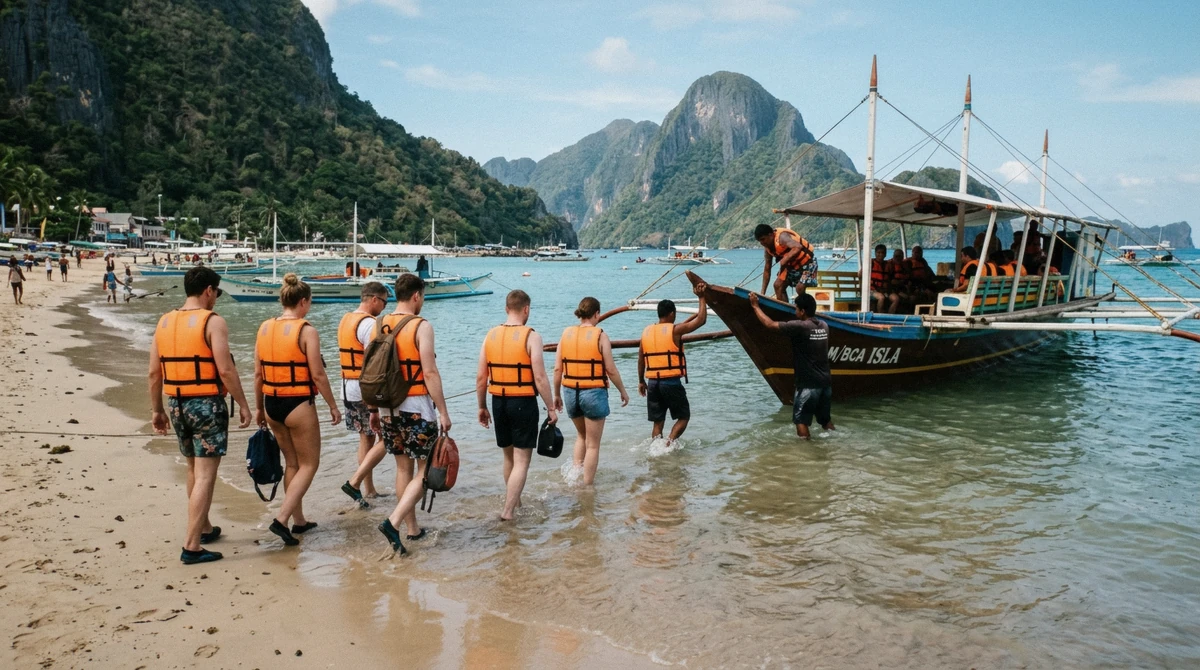
Quick answer The clearance, the vests, and the stops that ask something of you
Boats sail only on a Coast Guard clearance issued each morning around 9:00, and every listing here carries life vests. A shared bangka takes 15 to 25 people. The risks worth planning for are the wade out to the boat, the swim entries at three stops, sharp coral, and six hours of sun on an open deck.
Key takeaways
- There is no dock, so you wade out from the beach and back at every stop
- Reef shoes rent for about ₱100 and solve most of the coral problem in one go
- Wheelchair users are excluded on several listings, pregnancy on a Tour D boat, heart problems on one private day
- No listing states a minimum age, and the child fee and family routes are set out here
- Sheltered stops and short swims make the Tour D lagoons and coves the gentlest route
How Safe the Boats Actually Are
The boats are the least interesting part of the risk picture, because they are the part that is regulated. Everything that follows in this guide is about what happens after the bangka anchors.
The clearance and the equipment
No boat leaves the town beach without the morning Coast Guard clearance, which covers the whole fleet and is issued on wind, waves, visibility and any advisory in force. That is the single largest safety control in Bacuit Bay, and it is the reason a bright morning can still keep the boats in. Life vests are included on every listing compared here, carried aboard and handed out on request, and crews expect weak swimmers to wear one in the water rather than only on the deck.
Bangkas are outriggers, wide and stable, and the crews run the same four routes daily through the season. Shared boats carry roughly 15 to 25 passengers with two or three crew and a guide; private boats typically take 8 to 10, which changes how quickly anyone notices you are not back aboard. If the sea closes the day entirely, what happens to your booking is covered here.
The wade out, and other unglamorous risks
There is no dock in El Nido. You wade out to the boat from the beach, thigh deep or more depending on the tide, and climb a short ladder or step over the outrigger. The same happens in reverse at most stops, since bangkas anchor off the sand rather than beaching. This is where phones drown and where people with poor balance struggle, and it is worth mentioning to the crew before you board rather than while standing in the water.
Bring a dry bag. Keep passports and cash at the hotel and carry only what the day needs: the eco fee receipt, cash for the lagoon fee and kayak, and a card you do not mind getting damp. Bags sit on an open deck all day, out of sight while you swim.
Who the Listings Turn Away
Each operator publishes its own not-suitable-for list, and they do not match. The table below is exactly what the listings compared here state, with nothing added and nothing softened, because turning up to find the crew cannot take you is a bad way to start a morning.
Exclusions, listing by listing
Read this against the route you are considering rather than as a general rule for El Nido. Where a listing states nothing, that is what it states, and the honest reading is to ask the operator rather than to assume you are covered. The last column gives the practical move.
| Listing | Route | Not suitable for | What to do |
|---|---|---|---|
| Shared lagoons and beaches boat | Tour A | Wheelchair users, travellers with mobility impairments | Consider a private boat, where the crew can adapt the stops |
| Shared Tour A with a longer lagoon stop | Tour A | Wheelchair users | Ask about the kayak transfer at the Big Lagoon inlet before booking |
| Joiner boat with buffet lunch | Tour A | Nothing stated | Message the operator with your specific need and get it in writing |
| Private Tour A boat | Tour A | Wheelchair users | The private format still helps, since stops can be skipped or shortened |
| Shared Tour B with the caves | Tour B | Travellers with mobility impairments | The cave entries are the reason. Skipping them leaves three easy stops |
| Private Tour C boat | Tour C | Wheelchair users | Longest open-water crossing of the four routes, worth weighing separately |
| Shared Tour D lagoons and coves | Tour D | Pregnant women, mobility impairments, wheelchair users | The only listing here that names pregnancy; a private boat is the alternative |
| Tour D with fees included | Tour D | Nothing stated | Same route as above, different operator, so ask directly |
| Private A and C highlights | Tours A and C | Travellers with mobility impairments, people with heart problems | Seven hours and two routes; the pace is the reason for the heart clause |
Age, children and the gaps in the lists
No listing compared here states a minimum age, and none states a maximum. That means the decision sits with you and the operator rather than with a printed rule, so message them with the ages before booking and keep the reply. Children pay a reduced eco fee and under sixes pay none, and the routes that suit families are picked apart in the guide to island hopping with kids, which owns that side of the question.
The pattern across the table is worth naming. Wheelchair access is the most commonly excluded, mobility impairment next, and pregnancy and heart conditions appear once each. Some listings state nothing at all, which is not permission. Where a route involves a kayak transfer, a swim entry or a rock scramble, the exclusion is usually about that specific stop rather than about the boat.
The Parts That Need Swimming
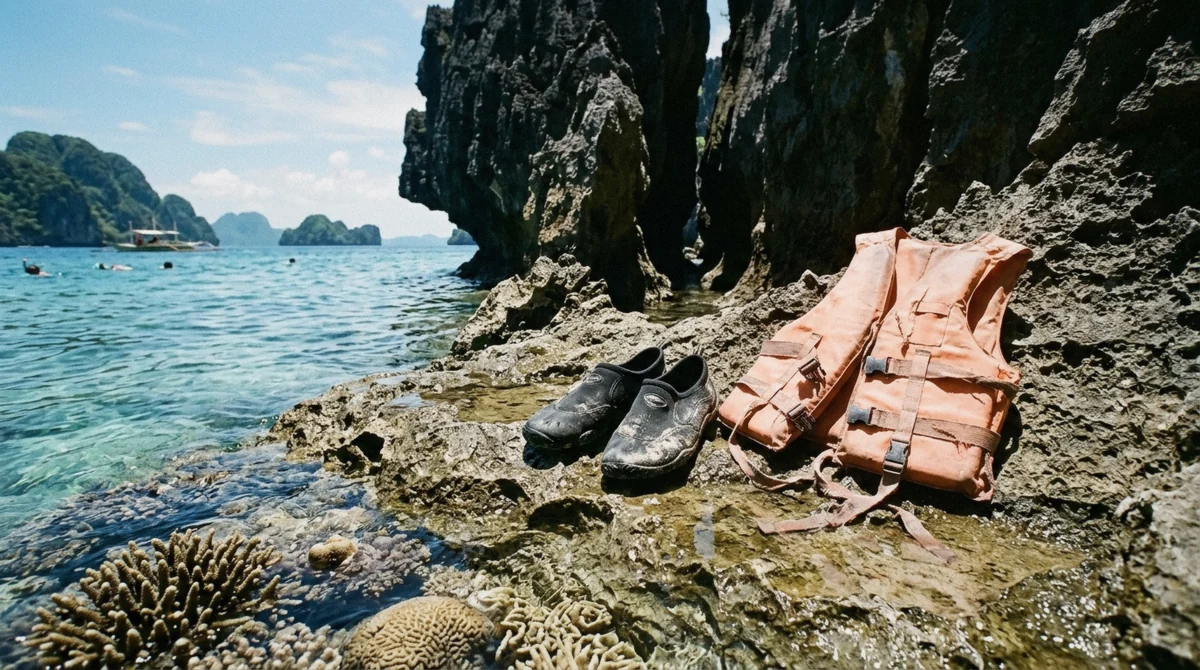
Four stops across the four routes need you to get in the water and go somewhere, not just splash near the boat. None is long, and all of them are optional, but knowing which is which decides whether a non-swimmer books that route.
The four entries that ask something
The Secret Lagoon on Tour A is entered through a hole in the rock: a short swim or a wade at low tide, with a lift over the lip. Hidden Beach on Tour C is reached by a wade of roughly 200 metres over shallow reef, in water that can be knee deep and sharp underfoot. Secret Beach on the same route is a swim-through, a gap in the cliff with a surge running in it. Cudugnon Cave on Tour B is a crawl through a small opening and a scramble inside, and Cathedral Cave is entered by swimming or paddling in.
The Matinloc Shrine viewpoint on Tour C adds a rock climb rather than a swim. None of these is technical. All of them reward reef shoes and a life vest, and any of them can be sat out on the boat, which crews expect and plan for.
The kayak sections
Both lagoons are kayak-only, because motorised boats may not enter them. That makes paddling less an activity than a transfer: at the Big Lagoon on Tour A and at the Small Lagoon on Tour D, the kayak is how you get in. Two-seaters rent for around ₱300 to 350 and a three-seater for about ₱500, on top of the ₱200 users fee.
Tide is the variable nobody mentions. At high water you paddle straight through the inlet; at low water boats anchor further out and you walk or drag the kayak over gravel and broken coral, which is the single best argument for reef shoes on this trip. Kayaks are stable and guides help launch them, but they need two working arms and a shoulder that tolerates repetitive work, and that is the practical reason mobility appears on so many exclusion lists.
What the Water Holds
Bacuit Bay is a benign place to swim by the standards of tropical seas, and the hazards that do exist are predictable and manageable with cheap gear.
Coral, urchins and jellyfish
Sharp coral and rock underfoot are the most common cause of injuries on these routes, and they are concentrated exactly where people walk: the lagoon inlets, the wade into Hidden Beach and the shallow entries at the beaches. Reef shoes rent for about ₱100 a pair in town and solve most of it. Standing on coral also damages it, so the crews ask you not to, and the two reasons point the same way.
Jellyfish appear at the lagoons in some months. Travellers report them without any predictable pattern, so treat them as a possibility rather than a season: a rash guard covers the parts that get stung and doubles as sun protection. Ask the crew before getting in, since they are on that water daily and know what came through this week. Nothing here is aggressive, and there are no reports of dangerous marine animals on these routes.
Boats, currents and the food
Stay inside the swimming area the guide points out. Bangkas moving between anchorages are the real hazard at busy stops, and their outriggers sit low and wide, so a swimmer crossing the channel is hard to see. Currents are mild inside the lagoons and stronger in the strait crossings, which is another reason the swim entries on Tour C are worth respecting.
One more thing to plan for: lunch sits on the boat for hours in the heat. Since 2023 cooking is not permitted on the boats or the islands, so food is prepared onshore in the morning and carried, and the day's timings are set out in the itinerary guide. Travellers have reported food left at room temperature on some boats. Ask how lunch is stored, eat the grilled items first, and carry a snack if you have a sensitive stomach.
Sun, Heat and the Open Deck
Sunburn is the injury most people actually leave with, and it is the easiest one to design out of the day.
Six hours on the water
The routes run six to eight hours, most of it between eight degrees north of the equator and a reflective sea. Bangkas carry a canvas roof over part of the deck, but the seats are open at the sides, the crossings happen in the middle of the day and every stop puts you back in direct sun. A rash guard beats sunscreen in the water: it does not wash off, it does not need reapplying after every swim, and reef-safe formulations still thin out within twenty minutes of snorkelling.
Wear a hat with a strap, since anything loose leaves on the crossing. Bring more water than feels sensible. Water is included on the listings here, but heat plus salt plus a full day gets through it, and floating vendors sell drinks at some stops for cash only.
The gear list that removes most problems
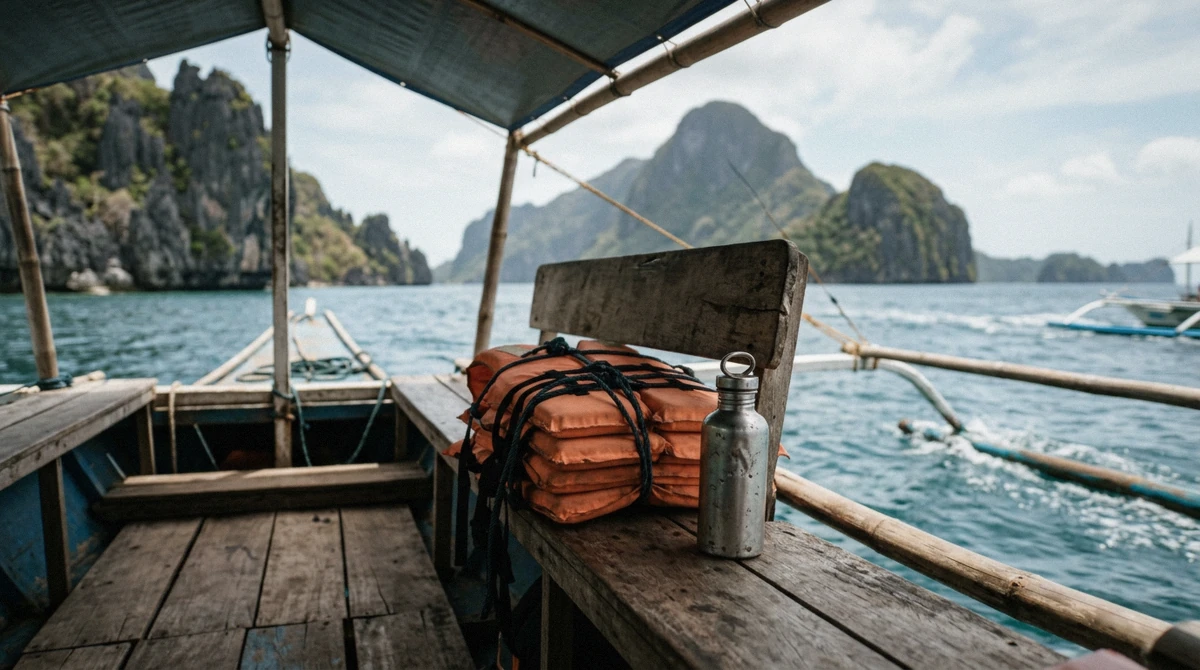
Five cheap items cover almost everything in this guide. Reef shoes at about ₱100 handle the coral and the lagoon walks. A rash guard handles sun and jellyfish together. A dry bag handles the wade out and the open deck. A refillable bottle is a requirement rather than a nicety, since plastic bottles are banned on the tours. Motion sickness tablets, taken before boarding rather than when you feel it, handle the crossings on the more exposed routes.
Snorkel gear and a life vest are inside the fare on the listings compared here, and towels and water shoes rent for about ₱100 each where you have not brought your own. None of this needs buying in advance, and all of it is available on the strip in town the evening before.
What the Crews Ban on Board
The rules on a bangka are short and enforced, and most of them exist to keep the bay intact rather than to keep you safe. Breaking one in front of a crew is a fast way to sour a day everyone else is enjoying.
The list, and why each rule is there
Plastic bottles and plastic bags are banned outright on the tours, which is why a refillable bottle is on the packing list rather than optional. Littering is banned and so is smoking on board. Alcohol is not permitted on the shared boats, though floating vendors sell soft drinks and beer at some stops for cash, and private charters set their own line on this.
Touching marine life is banned, along with taking or handling animals, plants, shells and coral. Standing on coral falls under the same rule and is the one people break by accident, in the shallow entries, which is another argument for reef shoes and for asking the guide where to walk. The lagoons carry their own etiquette: no motorised boats inside, keep to the paddling lines, and stay quiet enough that the next kayak gets the same place you did.
The fees the crews check
The Eco-Tourism Development Fee is collected before boarding and the receipt is checked out in the bay, so keep it dry and keep it with you. The lagoon users fee is collected on arrival. Crews are not being difficult about this: the fees are municipal and the checks happen at the sites, not at the office.
Cash matters here in a way it does not on a booked tour elsewhere. There is no card payment on a boat and none at a lagoon gate, and the cash machines are in town, not on the water. Bring the day's cash in small notes, in a dry bag, and the full breakdown of what the crew collects is worth reading before you leave the hotel.
If Something Goes Wrong
Two different failures are worth having a plan for: something happening to you on the water, and something changing before you get there.
On the day
Tell the guide first. Every shared boat carries a guide as well as crew, they run these stops daily and they know which islands have a clinic, which have shade and how long the run back to town takes. Minor cuts from coral are the common case and they need cleaning properly rather than seawater and hope, so a few plasters and antiseptic in the dry bag are worth their weight.
If you cannot manage a stop, sit it out on the boat. This is normal and nobody hurries you off. If seasickness hits, the deck rail beats the cabin, and the crossings are the worst part rather than the anchorages. El Nido has clinics in town and the nearest hospital is a drive away, which is a reason to carry travel insurance details rather than a reason to worry.
Before the day
Cancellation runs through the booking platform rather than through the crew, and every listing compared here cancels free up to 24 hours before the start time. If a medical condition, a pregnancy or an injury surfaces after you have booked, that window is your route out, and using it early costs nothing. Inside 24 hours the fare is not refundable, which is worth knowing before you gamble on feeling better in the morning.
If a listing's exclusions rule you out, the answer is usually a private boat rather than no boat: a crew running for one party can shorten stops, skip an entry and adapt the day. The trade-off in price and what it buys is set out in private against shared boats, and the routes themselves are compared across the full El Nido catalogue.
Which Route Suits What You Can Do
If You are a weak swimmer or nervous in open water
Tour D. The lagoons are sheltered, the coves are shallow, and the swim entries are the shortest of the four routes
If A listing names your condition in its exclusions
Do not book that listing. Message a private operator with the specifics and get the answer in writing before paying
If You want the swim-throughs and the caves
Tour C for Secret Beach and Hidden Beach, Tour B for Cudugnon and Cathedral Caves. Reef shoes on both
If You burn easily or cannot take six hours of sun
A shorter route on a private boat, a rash guard, and a seat under the canvas on the crossings
If You are travelling with young children
The family routes and the child fee are covered separately, and no listing here states a minimum age
Safety Questions About El Nido Boat Tours
Is island hopping in El Nido safe?
For most travellers, yes. Boats sail only on a clearance issued each morning for the whole fleet, every listing here carries life vests, and each boat has crew plus a guide. The risks that show up in practice are cuts from coral, sunburn on an open deck for six to eight hours, and the wade out to a boat that has no dock. All three are managed with cheap gear bought the evening before.
What safety equipment is carried on an El Nido bangka?
Life vests are included on every listing compared here and are handed out on request rather than only in an emergency. Snorkel gear is included on the listings here too. Boats carry crew of two or three plus a guide who runs the stops, and the outrigger hull is stable in the conditions the clearance permits. Nothing more specialised is stated on the listings.
Who cannot join an El Nido island hopping tour?
It depends on the listing rather than on the town. Several of the listings compared here exclude wheelchair users, several exclude travellers with mobility impairments, one excludes pregnant women on a Tour D boat and one excludes people with heart problems on the private A and C day. Some state nothing at all, which is not the same as clearance. The full table sits above.
Do you need to swim to do an El Nido island hopping tour?
Not to do the tour, but yes to do several of its stops. The Secret Lagoon entry, the swim-through into Secret Beach and the cave entries on Tour B all need you to be comfortable in water, and Hidden Beach involves a wade of about 200 metres over shallow reef. A life vest makes all of them accessible to weak swimmers, and every one can be watched from the boat instead.
What should you watch out for on an El Nido boat tour?
Sharp coral underfoot at the shallow entries, sun on an open deck all day, jellyfish at the lagoons in some months, and boats manoeuvring at busy anchorages. Reef shoes at about ₱100, a rash guard and staying inside the area the guide marks cover most of it. Lunch is carried from shore, so ask how it is stored if you have a sensitive stomach, and the day's timings explain why.
Nothing here should put anyone off a boat day. The bay is a straightforward place to swim, the clearance system keeps the fleet in when it matters, and the fixes are a pair of reef shoes, a rash guard, a dry bag and a question asked before booking rather than on the sand.
What changes most between routes is how much they ask of you, so start from what you are comfortable doing and work back to the boat. Every route, inclusion and exclusion is laid out in the El Nido island hopping catalogue.