 El Nido Island Hopping Tour
El Nido Island Hopping Without a Tour: What You Can Reach on Your Own
Last reviewed September 2026
El Nido island hopping without a tour buys you a real day on the water and none of Bacuit Bay. The sand you can reach alone, Las Cabanas and Marimegmeg, Corong-Corong, Nacpan, Duli and Lio, is a tricycle, a motorbike taxi or a rented scooter away, and it costs very little. Everything the boats visit sits behind open water: the two lagoons, Secret Beach, Snake Island, the caves. This page prices both halves of the choice, the land day and the joiner seat, and shows the party size at which hiring a whole bangka finally undercuts paying per person. The seats themselves sit in every El Nido boat route on one page.
Quick answer What the land day gets you, what it cannot, and where the maths flips
A joiner seat on a shared boat books from $22 to $28 with lunch, a guide and a life vest inside the fare. A day on the land beaches costs a ₱50 to 150 tricycle hop plus whatever you rent. The split is clean: sand is cheap to reach on your own, water is not. No stop on Tours A to D can be walked to.
Key takeaways
- Las Cabanas and Marimegmeg, Corong-Corong, Nacpan, Duli and Lio need no boat at all
- The ₱400 eco fee and the ₱200 lagoon fee apply either way, and the cash side is broken down per route
- Kayak rental on the open beaches runs ₱300 to 500 for two to three hours, well under a lagoon kayak plus its fee
- A whole bangka charter starts near ₱6,000, so going it alone beats a joiner from about five people up
- For the lagoons there is one route in, and the shared Tour A boat is the cheapest seat on it
The Short Answer: Do You Need a Boat Tour?
Two different questions hide inside this one, and they have opposite answers. Whether you can enjoy El Nido without booking a boat: yes, easily. Whether you can see what the photographs show without booking a boat: no.
What you keep by staying on land
The coast either side of town carries some of the longest beaches in northern Palawan, and all of them are road-served. Marimegmeg, usually called Las Cabanas, is a fifteen minute tricycle ride south and has bars along the sand and a 750 metre zipline over the water to Depeldet Island, ₱500 one way or ₱900 return. Corong-Corong sits between town and the port and takes the sunset. Nacpan runs for four kilometres of open sand up the north coast. None of them charges an entry fee, none of them needs a schedule, and you leave when you want rather than when the crew calls time.
The money argument is real too. A land day can cost under ₱500 all in, and the two things people most regret about a boat day, the fixed timetable and sharing a small beach with other boats, do not exist on a beach you reached by scooter.
What only a boat gets you
Bacuit Bay's limestone islands start about two kilometres offshore and there is no road, no ferry and no swimmable line to any of them. The Big Lagoon, the Small Lagoon, Secret Beach, Hidden Beach, Snake Island, Entalula, Helicopter Island and the two caves are boat-only, and that is the whole of Tours A, B, C and D. Sea kayaks rented in town are not permitted to cross to the islands on their own, and the distances plus the afternoon wind make it a poor idea in any case.
So the decision is not really DIY against a tour. It is whether the islands are the reason you came. If they are, one boat day covers them and the rest of the trip can be as independent as you like.
DIY and a Joiner Boat Side by Side
The two options answer different needs, so comparing them on price alone gets you the wrong answer. The table sets them against each other on the five things that decide the day, with the last column naming who each one actually suits.
The two days compared
The figures below are per person for one day. The joiner column uses the fares on the shared listings compared here, $22 to $28, plus the pesos the crew collects on the morning. The land column assumes a shared tricycle to a nearby beach and one kayak rental, with the eco fee spread across the trip because it is charged once and stays valid for ten days.
| On your own by land | Joiner boat | |
|---|---|---|
| Cost per person | ₱50 to 150 in tricycle fares, plus ₱200 to 500 for a kayak if you want one | $22 to $28 for the seat, plus ₱400 eco fee and ₱200 lagoon fee where the route enters one |
| What you can reach | Las Cabanas, Corong-Corong, Nacpan, Duli, Lio and the town beach | The lagoons, Secret and Hidden Beach, Snake Island, the caves, Entalula, Helicopter Island |
| Gear and food | Bring your own water and lunch, or eat at a beach bar; snorkel gear rents for about ₱150 | Lunch, water, snorkel gear, life vest and a guide are inside the fare on the listings here |
| Flexibility | Total. Leave at any hour, stay until dark, change plans at lunch | Fixed. Report at 8:30, sail after the morning clearance, back between 4:00 and 5:00 pm |
| Best for | Longer stays, budget trips, anyone who wants a beach to themselves | Short stays and first visits, where the islands are the point |
Where You Can Get on Your Own
Five beaches carry the land day, and they divide neatly by how far you are willing to ride. Two are a tricycle hop from the town beach, two need most of an hour on a motorbike, and one comes with an airport road and a resort strip.
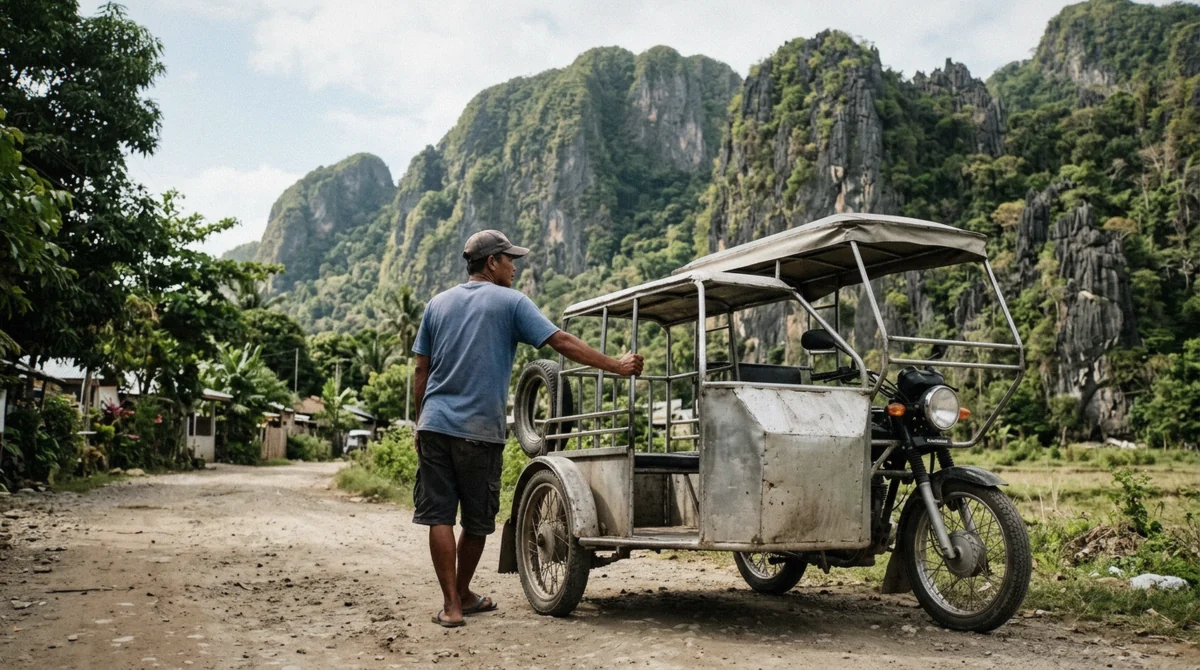
Las Cabanas and Corong-Corong, the tricycle beaches
Marimegmeg, which every driver calls Las Cabanas, is the default afternoon. It is a short ride south of town, the fare agreed before you get in, and the sand carries beach bars with day beds. Corong-Corong is closer still, a wide shallow bay on the way to the port, and it faces west so the sun goes down in front of you rather than behind the cliff.
Both work as half days. Ride out after lunch, swim, eat where you are, ride back after dark. Neither replaces the bay, and neither pretends to: the water is shallow and sandy rather than the deep turquoise that the lagoon photographs show. What they give instead is space, which the island stops rarely do.
Nacpan and Duli, the motorbike beaches
Nacpan is the one worth the ride. It sits about 45 minutes north of town and runs for kilometres, so even a busy day leaves you an empty stretch. Duli is farther again, quieter still, and picks up surf in the monsoon months.
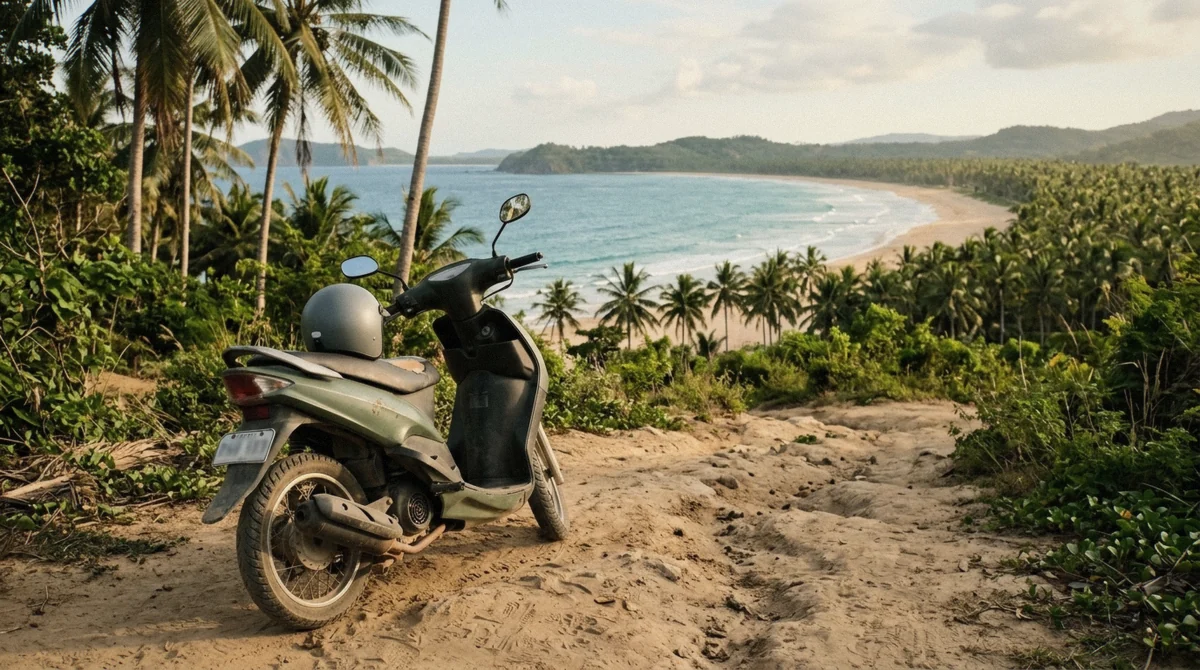
Getting there costs a motorbike taxi ₱300 to 400 one way including the driver waiting for you, or a scooter ₱400 to 500 a day if you would rather ride yourself. Take the scooter only if you have ridden one before: the last stretch has sand patches and the ride back after dark is unlit. Bring cash. The huts at Nacpan sell grilled fish and cold drinks, and nothing on that coast takes a card.
Lio and the town beach
Lio Beach sits by the airport north of town, a groomed resort strip with a long, clean beach and an easy tricycle or shuttle ride. The beachfront belongs to hotels but the sand is public, and it is the simplest swim in the area if you are flying out the same day.
The town beach itself is the one to manage expectations about. It is a working beachfront: bangkas are moored across it, boats load and unload all morning, and it functions as the harbour rather than as a swimming beach. It comes into its own at sunset, when the fleet is back and the bars fill, which is also the best time to walk the line of operator offices and ask what tomorrow's boats are doing.
What DIY Actually Costs
Every price below is per item and paid in cash on the day; nothing on the land day is bookable online. Agree transport fares before you get in, since almost none of it is metered and quoting after the ride is how the arguments start.
The land day, item by item
The last column is the one to read: several of these are worth paying for and one or two are not, depending on how long you are staying. The eco fee is the exception to everything here, because it follows you rather than the trip, and the receipt covers every site in the municipality for ten days.
| What | Price | Worth it when |
|---|---|---|
| Tricycle inside town and to Las Cabanas or Corong-Corong | ₱50 to 150 a hop, agreed before you get in | Always. Splitting it between three people makes it trivial |
| Motorbike taxi to Nacpan or Duli | ₱300 to 400 one way, with waiting time | You do not ride, or the road is wet |
| Scooter rental | ₱400 to 500 a day | Two or more days out of town, and you have ridden before |
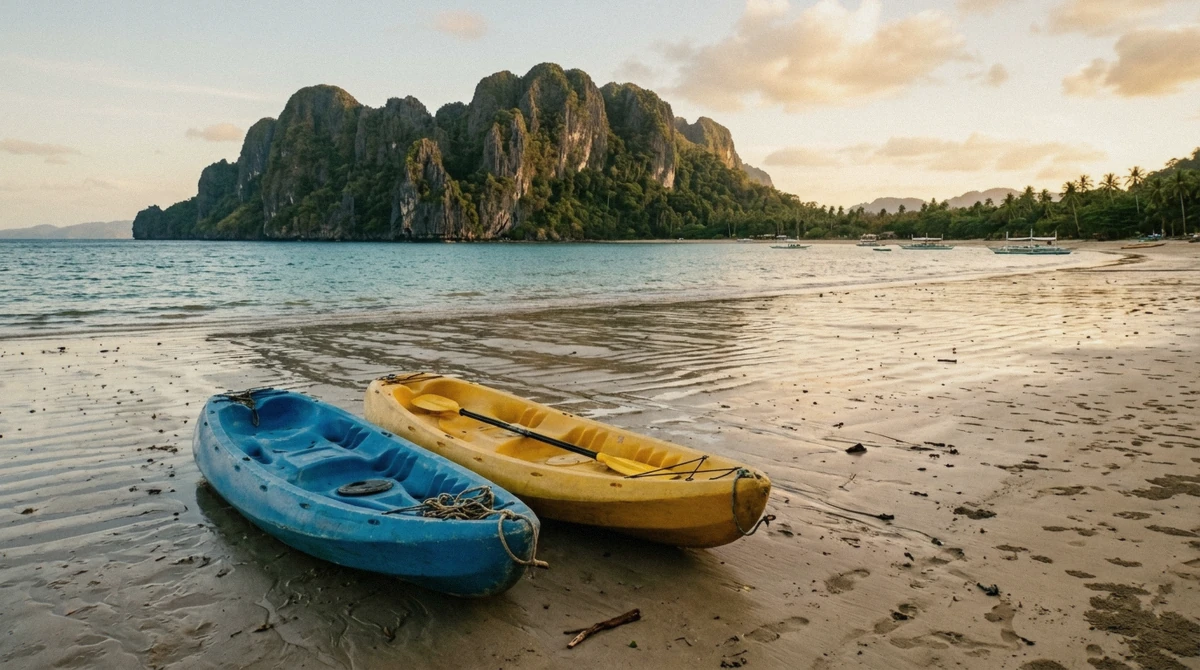
| Kayak at Corong-Corong | ₱300 to 500 for two to three hours | Flat morning water and you want to paddle the bay edge |
| Kayak at Nacpan | ₱200 to 400 for two hours | You are already there and the surf is down |
| Eco-Tourism Development Fee | ₱400 (about $6.40) once, valid 10 days | Charged the moment you take any boat, and by category |
What the fees do and do not cover
Two charges catch people who assume that skipping the tour means skipping the paperwork. The Eco-Tourism Development Fee is ₱400 (about $6.40) for a non-resident adult, paid once in cash at an operator's office or to a guide before boarding, and the receipt is checked by crews out in the bay. It is a municipal fee on the visitor, not a booking fee on the tour, so it lands on a chartered boat exactly as it lands on a joiner seat.
The lagoon users fee works the same way. It is ₱200 (about $3.20) per person at the Big Lagoon and ₱200 at the Small Lagoon, collected on arrival, and no boat gets you around it. Add the kayak, because motorised boats may not enter either lagoon, and the cheapest possible visit to a lagoon costs ₱400 plus ₱200 plus a paddle whichever way you arrive.
What You Cannot Reach Without a Boat
This is the short section, and it is the reason most people book anyway. Every headline stop in Bacuit Bay is boat-only, and there is no partial workaround worth the risk.
The boat-only list
The Big Lagoon and Small Lagoon, Secret Lagoon, Secret Beach, Hidden Beach, Snake Island, Cudugnon Cave, Cathedral Cave, Entalula Beach, Helicopter Island, Talisay and Matinloc Shrine: all of them need a bangka, and between them they make up the entirety of Tours A to D. There is no shuttle, no public boat and no swimmable route from the mainland to any of them.
The lagoons add a second layer. Motorised boats may not enter, so even after the bangka anchors outside you paddle in, and the ₱200 users fee is collected before you do. Nothing about arriving independently removes either step. The one thing an independent traveller can control is timing, and that is what the private boats that leave before the fleet sell.
The Big Lagoon question
The Big Lagoon comes up more than any other stop, so it is worth being exact. It sits on Miniloc Island, it is on Tour A only, and it is entered by kayak through a narrow inlet. Visitor guides put the cap at 400 visitors a day with allocated time slots, the earliest around 7:00 am, and one listing here states the practical consequence plainly: entry is limited, and if entry is no longer available the boat visits a different spot instead.
That is a scheduling system built around boat operators who hold slots. Turning up independently is not a route into it. If the Big Lagoon is the thing you came for, book a Tour A boat, ask what time it aims to arrive, and read how the two lagoons differ before choosing.
Chartering Your Own Bangka
The genuine DIY route to the islands is not a kayak, it is renting the boat. Operators in town charter whole bangkas by the day, and the arithmetic turns in your favour at a party size most people can guess.
What a whole boat costs
A private charter in town runs roughly ₱6,000 to 12,000 for the boat, crew and fuel, with the spread set by boat size, route and season. Booking offices usually take a deposit of about a quarter and the balance in cash on the day. The fee is for the vessel, so it splits however many of you climb aboard, up to the boat's own limit.
Against a joiner seat at ₱1,200 to 1,500 for Tour A, the crossover sits at about five people for a mid-priced boat, and lower if you take the cheaper end of the charter range. Below five the joiner wins on money; above it the charter wins on money and on everything else, because you also get the timing, the route order and an empty deck. The full break-even table, including the listings sold as private boats, sits in the private against shared comparison.
What chartering changes about the day
The stops stay the same. What changes is when you are standing on them. Shared boats leave the town beach together after the morning Coast Guard clearance, which puts the whole fleet at the same four places at the same four times. A chartered boat can start earlier or later, or run the route backwards, and arrive where the fleet is not.
A chartered boat can also mix routes, which a joiner boat cannot: shared boats run one fixed itinerary. That is how combined days exist at all, and the catalogue's own version is the private A and C highlights boat, which takes the best of two routes plus Entalula in seven hours. Charter does not exempt you from the eco fee, the lagoon fee or the kayak.
When Skipping the Tour Is the Right Call
There are trips where booking nothing is the better plan, and pretending otherwise would be dishonest. They have a pattern.
The cases where land wins
Long stays win on land. If you have a week, two beach days by scooter cost less than one boat day and leave you rested for the boat you do take. Rough weather wins on land too: when the southwest monsoon closes the bay the beaches are still open, which is the whole point of keeping a spare morning.
Seasickness and small children also point the same way. A shared bangka is six to eight hours on open water with a fixed return, and there is no getting off in the middle of it. So does budget travel at the sharp end: ₱400 for the eco fee plus a ₱1,200 seat is a real sum in a country where a beach day costs a tricycle fare. And if you have already done one route, a second is more of the same coastline; the marginal beach day may be the better spend.
The cases where the boat wins
Short trips lose on land. Two nights in El Nido and no boat day means seeing the mainland edge of a bay whose interior is the reason the town exists. The lagoons are not substitutable by any beach.
Groups of five or more should stop comparing joiner seats and price a charter instead. Snorkellers should take a boat, because the reef worth swimming sits off the islands rather than off the town beaches. And anyone travelling in the dry season with one free day should book that day early rather than keep it flexible, since a shared seat at $22 to $28 with lunch, guide and life vest included is the cheapest access to the bay that exists. Compare what each route covers across the four Bacuit Bay itineraries before picking one.
Which Version of the Day Fits You
If You have one full day in El Nido
Take a boat. The shared Tour A route covers the Big Lagoon, Secret Lagoon and two beaches in one go
If You are travelling as five or more
Price a whole boat. At ₱6,000 to 12,000 split between you it undercuts the seats, and the break-even maths sits here
If You have four days or more
One boat day plus land days. Nacpan by scooter at ₱400 to 500 a day, Las Cabanas by tricycle, and the bay once
If The sea is closed or you get seasick
Land beaches, all of them open in any weather. Keep the eco fee receipt, it stays valid for ten days
If You are counting every peso
Tricycle beaches plus one cheap joiner seat. The cheapest Tour A listing here still includes buffet lunch
Doing El Nido Without a Boat Tour: Common Questions
Can you go island hopping in El Nido without a tour?
Not in the sense the phrase usually means. The islands in Bacuit Bay have no ferry, no road and no safe swimming line from the mainland, so reaching them means being on a bangka, either a joiner seat or a boat you charter yourself. What you can do without any tour is the coast: Las Cabanas, Corong-Corong, Nacpan, Duli and Lio are all road-served, free to enter and open whenever you turn up.
Which El Nido beaches can you reach by land?
Five worth the trip. Marimegmeg, known as Las Cabanas, and Corong-Corong are both short tricycle hops from town at ₱50 to 150. Nacpan lies about 45 minutes north and Duli beyond it, both reached by motorbike taxi or scooter. Lio Beach sits by the airport and is the easiest of the lot. The town beach itself is a working harbour rather than a swimming beach.
How much does it cost to hire your own boat in El Nido?
A whole bangka with crew and fuel charters for roughly ₱6,000 to 12,000 a day in town, the range set by boat size and route, usually with a deposit of about a quarter and the balance in cash. The eco fee and any lagoon fee are separate and per person. Split between a group it lands close to joiner prices, and the comparison with private listings runs here.
Is it cheaper to island hop on your own in El Nido?
Below about five people, no. A joiner seat on the listings compared here is $22 to $28 with lunch, a guide, snorkel gear and a life vest inside it, which no charter matches per head. From roughly five people up the charter splits cheaper and you gain the timing as well. A pure land day is cheaper than either, and reaches none of the islands.
Can you reach the Big Lagoon without a tour?
No. The Big Lagoon is on Miniloc Island, motorised boats may not enter it, and access is by kayak from a bangka anchored at the inlet. Visitor guides describe a daily visitor cap with allocated time slots held by operators, and one listing here warns that if entry is no longer available the boat goes elsewhere. It is a Tour A stop, and the shared Tour A boat is the cheapest way onto it.
What can you do in El Nido other than island hopping tours?
Ride to the beaches, rent a kayak at Corong-Corong for ₱300 to 500 or at Nacpan for ₱200 to 400, snorkel off the town-side reefs, walk the operator strip at sunset, or take the Las Cabanas zipline out to Depeldet Island. A land day fills easily, and it is the natural fallback when weather closes the bay, which the cancellation guide covers.
Doing El Nido without a boat is a real trip, and a good one, so long as you know what it costs you: the lagoons, the caves and the beaches you cannot walk to. Ride out to the sand, keep the eco fee receipt, and put one boat day where the weather is most likely to hold.
When that day comes, the seat is the only decision left. Every route, fare and inclusion sits side by side in the El Nido island hopping catalogue.